What Live News Taught Me About Design Systems
Four years of designing for breaking news at Al Jazeera changed how I think about every brand I touch.
 Omar FawziSenior Art Director, Riyadh ·
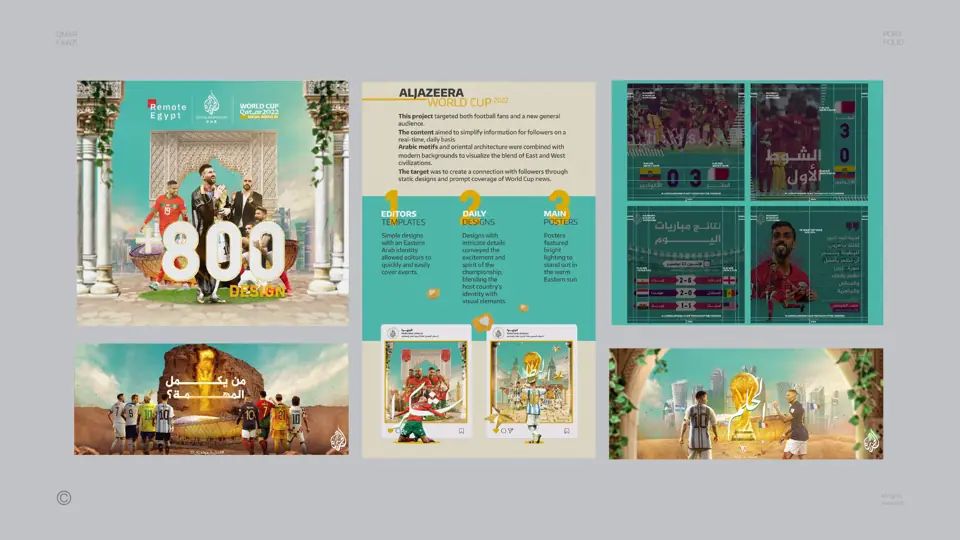
Most design work has a deadline. Live news has a clock that never stops. When I joined Al Jazeera Media Network as a Senior Graphic Designer, I thought I understood systems: grids, type scales, colour rules. Within weeks I learned that a system only proves itself when nobody has time to think.
A system is a set of decisions made in advance
During the FIFA World Cup Qatar 2022, our team produced graphics every hour of every day: line-ups, results, stories, explainers, video. Nobody could stop to decide which font size a score should be, or where a caption sits on a vertical video. Those decisions had to be made before the tournament started.
So we built them first. Every template answered a question before it was asked: what happens when a name is twice as long as expected, when Arabic and English sit side by side, when a story breaks at two in the morning and the only person online is a junior designer. The best compliment a system can get is that people stop noticing it.
Design for the worst day, not the launch day
The U.S. Presidential Elections in 2024 taught me a second rule. Candidate profiles, electoral maps, polls and live results all had to stay neutral, accurate and readable while numbers changed by the minute. A launch-day design looks perfect with clean, approved content. A real system has to look right with messy, late, incomplete content.
Now, whenever I build an identity for a brand, I test it against its worst day: the longest product name, the lowest-quality photo, the most rushed post. If it survives that, it will survive everything else.
Clarity is a form of respect
Covering the war in Gaza and the war in Sudan meant designing maps, timelines and data about real people in real pain. There was no room for decoration. Every visual choice had to serve one goal: helping the audience understand what was happening, quickly and accurately, with respect for the human context.
That discipline stayed with me. When a client asks for something to look more exciting, I ask first whether it is clear. Excitement is easy to add later; clarity is hard to rescue.
Speed comes from structure, not from rushing
People assume newsrooms are fast because designers work fast. In reality they are fast because the thinking is already done. Templates, naming conventions, file structures and motion rules turn a thirty-minute task into a five-minute one without lowering the quality.
I carried that into everything since: the Saudi Television visual refresh, government campaigns, and brand work through Omar Studio. A good system gives a team freedom, because nobody wastes energy on decisions that were already made well.
Three questions I now ask on every project
- What will this look like on its busiest, messiest day?
- Which decisions can we make once, so the team never has to make them again?
- If someone sees this for two seconds, what do they understand?
Live news is an extreme environment, but every brand has its own version of breaking news: a launch that moves, a campaign that changes overnight, a team that grows faster than its guidelines. The brands that cope are the ones whose systems were designed for that day.